



How Carla Connor redefined feminine power, resilience, and complexity on British television’s most iconic street.
Please note, this article contains mention of mental health and assault storylines.
For nearly two decades, Coronation Street’s Carla Connor has stood as one of the most captivating figures on British television. First arriving on the cobbles in 2006 as a sleek, sharp-tongued businesswoman, Carla quickly defied expectations. She wasn’t a traditional soap heroine, not the long-suffering wife, nor the scheming seductress. Instead, she emerged as something rarer: a complex, powerful, and deeply flawed woman with ambition in her bones and trauma in her past.
In a genre long criticised for relying on tired tropes and flat female characters, Carla became something else entirely, a character who redefined power and resilience for women in soap operas. As her story evolved, so did our understanding of what strength, leadership, vulnerability, and love could look like on screen.

Carla’s arrival: Power in heels
Carla first strutted onto our screens in stilettos and confidence, a savvy, fashion-forward force in a world of gossip and pints. She wasn’t looking to win anyone’s approval, least of all the men around her. She had ambition and the confidence to pursue it unapologetically. In an era where soap women were still too often boxed into domestic roles, Carla starting a business as soon as she arrived on the cobbles (albeit using her husbands factory to make the products) signalled a turning point.
She commanded her role as a strong female character. From the outset, Carla set herself apart. She sparred with business contacts, challenged male egos, and made deals with a level of grit and cunning that had typically been reserved for male characters in the genre.

The business of being a woman in charge
Running the factory was never just about money, it was a battleground for Carla’s identity. She’d always faced resistance from men who resented her power: Tony Gordon, Frank Foster, Nick Tilsley and Peter Barlow in more recent times. Each man she clashed (or fell in love) with reflected a different dimension of the challenges powerful women face in both love and business.
In relationships, Carla was rarely ‘softened’ for the screen. She remained bold, sometimes icy, sometimes passionate, but always fiercely independent, even when she was vulnerable. Her marriage to Peter Barlow, for example, was a dramatic blend of loyalty, betrayal, and co-dependency. Her relationship with Nick came with a similar dose of intensity, ambition, and manipulation.
Carla’s male relationships often mirrored the broader power dynamics in her life: men trying to manage, fix, or even overpower her, and Carla refusing to be defined by them.

Breaking the illusion: Carla’s vulnerability and mental health
Carla’s strength came from a complicated history of trauma. Rape, kidnapping, a miscarriage, and later, a severe mental health crisis that pushed her to the brink. Coronation Street handled her breakdown storyline in 2019 with incredible sensitivity. Her mental health wasn’t written off as a plot twist; it was treated as a vital part of her character’s journey.
In allowing Carla to fall apart, Corrie gave viewers something rare: a powerful woman who wasn’t just strong in spite of her struggles, but because of how she faced them.
Her psychosis storyline, in particular, marked a major shift in how soaps portray female mental health. It showed a woman brought to her lowest, rejected by many around her, and still determined to rebuild, on her terms.

Carla’s love life reimagined: Enter Lisa Swain
In a bold turn, Carla’s recent connection with Lisa Swain has breathed new life into her arc, and challenged the expected narrative yet again. Their relationship isn’t just a surprising twist, it’s a refreshing departure from Carla’s previous entanglements with emotionally unstable or domineering men.
Lisa brings an exciting yet grounded presence into Carla’s life. A police officer with her own moral compass, Lisa is someone who understands control, duty, and trauma (even though we don’t actually know how much of Carla’s background has been shared with Lisa at this point), but also offers a kind of emotional intimacy Carla has rarely experienced. Where her relationships with men were often volatile, competitive, or controlling, Lisa’s approach is steady, respectful, and quietly supportive.
This isn’t a storyline about Carla ‘changing teams’, it’s a story about emotional compatibility, timing, and personal evolution. It’s a queer storyline written not for shock value, but with sincerity, giving both characters space to develop authentically and at a natural pace. And for Carla, it represents a new chapter in how she gives and receives love, not from a place of drama, but of peace.
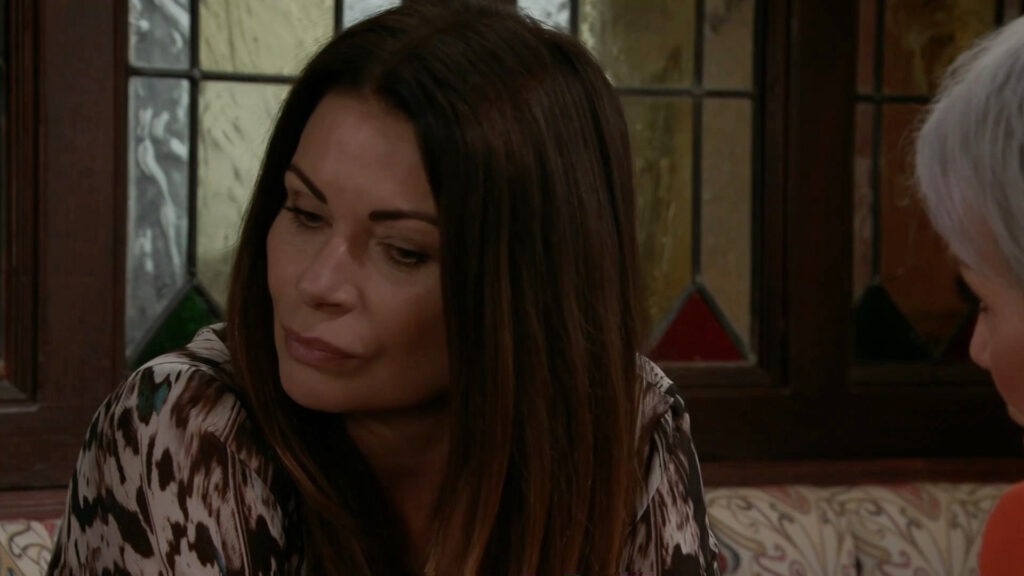
Feminism in full colour
What makes Carla so compelling is that she doesn’t need to be likeable to be loved. She’s made bad decisions. She’s hurt people. She’s lied, cheated, lashed out, but she owns her flaws. In an industry that still too often sanitises female characters, Carla’s moral ambiguity is a breath of fresh air.
She’s not a saint, and not a villain. She’s simply human, and that’s what real power looks like. Her feminism isn’t theoretical. It’s lived, bruised, and constantly evolving.
Unlike many female leads, Carla’s strength doesn’t come from sacrificing her femininity, nor is it softened to make her more palatable. She’s a reminder that women don’t have to be perfect to be powerful.

Carla’s legacy and the future of female storytelling
Carla Connor helped carve out space in British soaps for characters who are unafraid to lead, to fall, and to rise again. Her storylines opened the door for deeper, riskier storytelling about women, particularly those navigating mental health, trauma, and power without being reduced to specific narratives.
As newer characters arrive on Coronation Street, it’s worth asking: will we see another Carla? Perhaps not. But her influence lingers, and whenever a new female character arrives on the cobbles, Carla’s DNA is there, encouraging soaps to take women seriously.

Carla’s evolution is more than just a character arc, it’s a statement. She’s a symbol of strength shaped not just by power, but by pain, complexity, and growth. And as she steps through the door of Number 6 Coronation Street, and into the next phase of her relationship with Lisa, we’re watching a woman who has finally started to rewrite her own rules, not just survive them.
Her legacy? A new template for what female power looks like on television. Layered, resilient, and unapologetically real.
S xo
Images copyright of ITV